Inaccurate Fuel Level Sensor Data and Fleet Compliance Risk
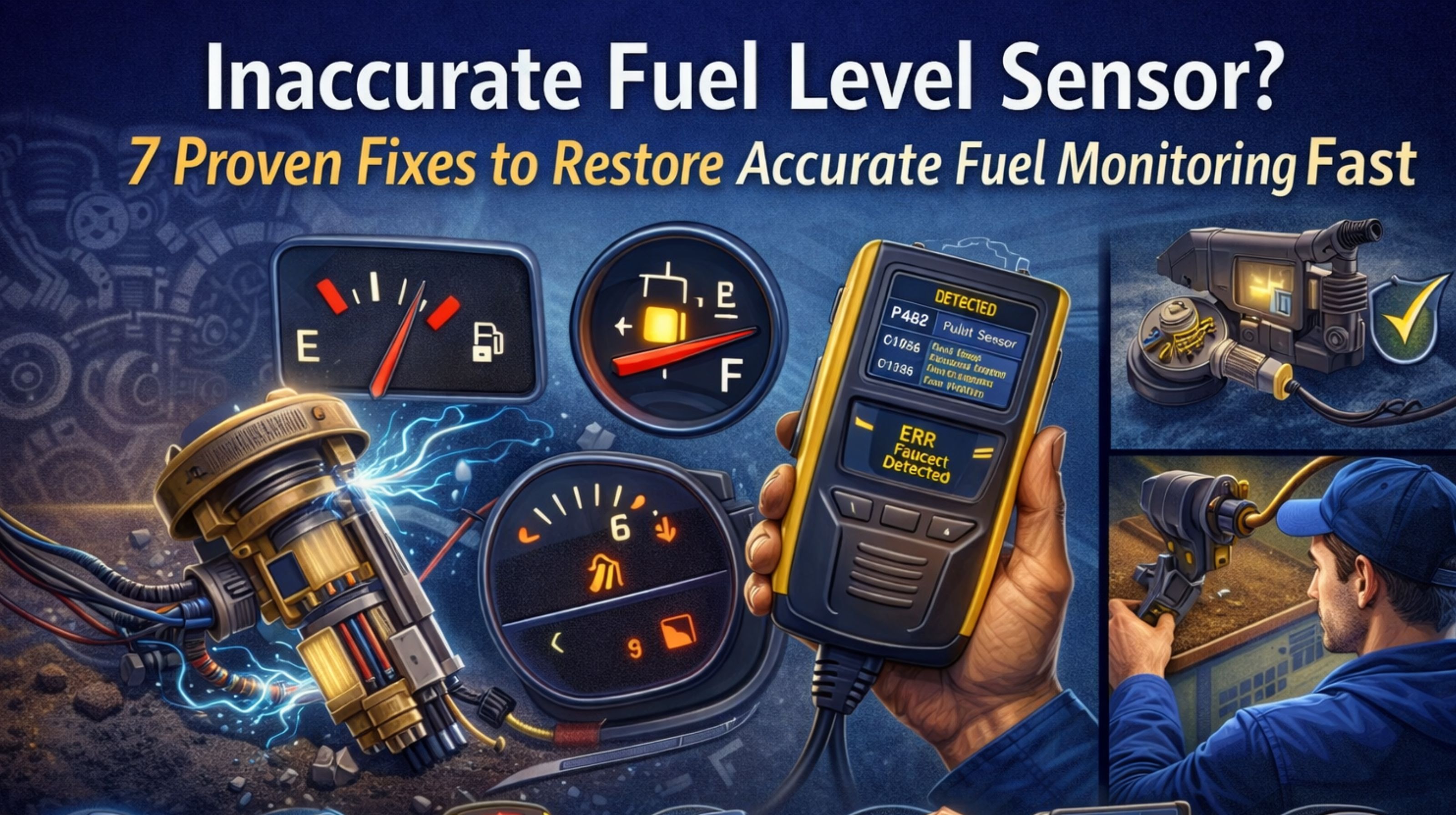
Inaccurate Fuel Level Sensor Data and Fleet Compliance Risk
An inaccurate fuel level sensor isn't just a bad number. It's a cascading failure in fleet tracking that creates phantom fuel loss, triggers false theft alerts, and leaves you exposed during a fuel tax audit. You see it in the real world: a sensor reporting 80% full while the driver is stranded, or a midnight alert for a sudden fuel drop that was just a parked truck on a slope.
What Inaccurate Fuel Sensor Data Means for Live Fleet Tracking
In live operations, this inaccuracy means delayed or missed geofence alerts for refueling, which corrupts your fuel performance baselines. Here's the non-obvious part: many sensor calibration routines are temperature-sensitive. They can fail after a cold soak, reporting a stable but wrong value that your fleet management software trusts completely. That's how you get a silent data error that no one notices until it's a problem.
Reality Check Under Real Vehicle Scale and Load
At scale, even a 5% systematic error across 100 vehicles distorts monthly fuel spend by thousands. It makes route optimization for efficiency a guess. The real boundary condition is tank shape. A cylindrical vs. elliptical tank has a non-linear fill curve, and a generic calibration will never be accurate. This gets especially bad during partial refuels or when the vehicle is on an incline—a common misunderstanding that causes a lot of unnecessary escalation.
Failure Patterns and the Wrong Assumption
The critical failure pattern is assuming the sensor itself is faulty. Often, the issue is actually in the integration layer or the reporting interval. A sensor might send correct raw resistance values, but the telematics device firmware or the API integration maps them incorrectly. That leads to wasted replacements and, worse, ongoing compliance gaps in your reported data that you think you've fixed.
Decision Boundary: Recalibrate, Reconfigure, or Replace
The choice comes down to this: if the inaccuracy is consistent and off by a fixed percentage, you recalibrate in the software. If the data is erratic or drops out, check the wiring and sensor ground. The line where internal fixes stop is physical sensor failure or a fundamental tank shape mismatch. At that point, hardware replacement is the only path. And your platform, like gps controller, has to handle the new sensor's data profile without corrupting your historical logs.
FAQ
q Can a software update fix my inaccurate fuel sensor?
a Only if the inaccuracy comes from the calibration table or data interpretation in the telematics firmware. A physically failed or degraded sensor needs hardware intervention.
q Why does my sensor show accurate levels sometimes but not others?
a This usually points to environmental factors—temperature, vehicle incline, or fuel slosh. It often reveals a calibration that's only valid for a specific tank level or condition, which is a real audit risk.
q How does sensor inaccuracy create a compliance risk?
a Inaccurate fuel logs lead to incorrect IFTA tax reporting. They can also trigger false fuel theft investigations. Both are serious liabilities if you get audited on your asset monitoring.
q When is it no longer worth trying to fix an inaccurate sensor?
a When the cost of repeated diagnostics, driver reports, and corrupted data exceeds the replacement cost and risk. That's when the decision shifts to installing a new, compatible sensor and re-integrating its data stream.


Comments
Post a Comment