GPS tracking unit offline after firmware crash and fleet visibility loss
GPS tracking unit offline after firmware crash and fleet visibility loss
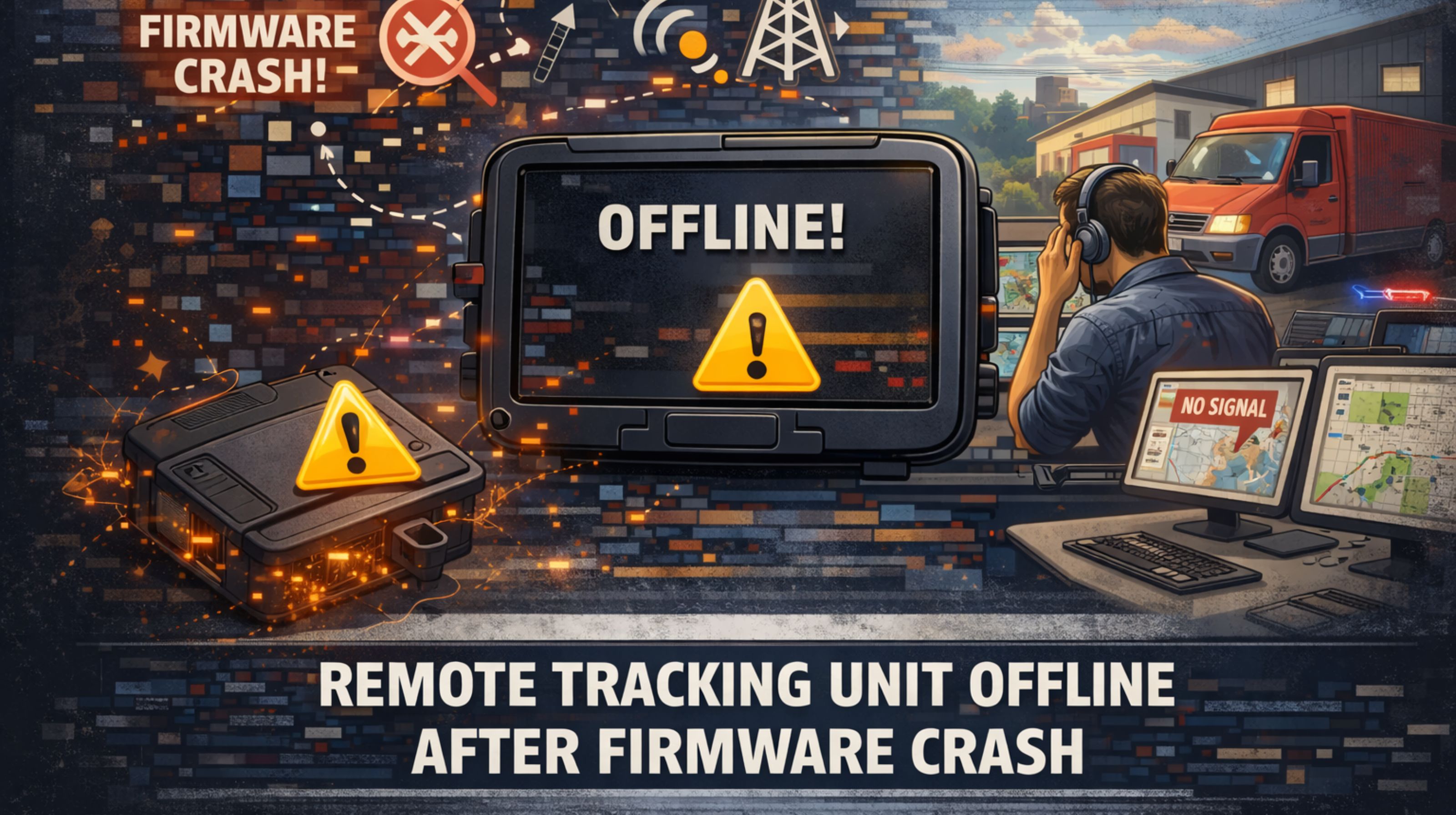
When a remote tracking unit goes offline from a firmware crash, it's more than a blip on the map—it's a total blackout. You lose vehicle location, status, everything. This usually happens quietly, after some update, and the device just stops talking to your fleet management software. One minute it's an asset, the next it's a ghost in the system.
What a firmware crash means for live fleet tracking
A firmware crash basically bricks the device's core instructions. GPS sampling stops, the cellular modem goes quiet, sensor data halts. What you'll see is the unit stuck rebooting over and over, or maybe powered on but sending no signal. That's a dangerous gap. Speeding, harsh braking, someone moving the vehicle—it all goes unreported. It's not like a poor signal; the device isn't even trying to call home.
Reality check under real fleet scale and load
At scale, one crash can start a cascade. A bad update sent to a group of devices? That can take dozens of vehicles offline at the same time. Suddenly your team is swamped with manual recovery. From what I've seen in fleet logs, these crashes often line up with specific things—like a cellular network handoff, or a voltage dip during the update. The standard health dashboards usually miss those signs, so you're stuck reacting instead of getting ahead of it.
Common mistakes that escalate the tracking failure
The big one is thinking a power cycle will fix a corrupted firmware image. Sometimes that just makes it worse. Another critical error is waiting too long to deal with it. Every day offline punches a hole in your ELD/HOS logs and audit trails. And teams often blame cellular coverage first, wasting days checking networks when the real problem is the device's firmware partition. You only see that in the specific diagnostic modes, which a lot of people don't check right away.
Decision help: reflash, replace, or redesign the tracking layer
You're basically choosing between two things: try to reflash the firmware, or just replace the unit. The line is pretty clear. If the device will accept a reflash command and boot up stable, you can recover it. If the bootloader itself is corrupted, or the hardware is just old, replacement is your only real path. For fleets that see this happen again and again, the fix is redesigning the update process—using dual memory partitions and staged rollouts. That's a core feature you'd want from a solid gps controller platform, to stop a fleet-wide blackout before it starts.
FAQ
q: How can I tell if my GPS tracker is offline from firmware crash vs no signal?
a: Check the raw comms log in your platform. A firmware crash shows zero transmission attempts—nothing. A unit with no signal will still show it's trying to register with the network every so often.
q: What is the biggest compliance risk from a firmware-crashed tracker?
a: Losing ELD mandate compliance. It creates unaccounted drive time, and that's a sure way to get violations if the DOT does an audit.
q: Can a firmware crash affect an entire group of tracking devices at once?
a> Yes, absolutely. If a flawed firmware update gets pushed over-the-air to a batch of devices, it can brick multiple units at the same time. That's a mass visibility outage.
q: When should I stop trying to fix a crashed unit and just replace it?
a: Replace it if the device won't enter recovery mode after a few solid attempts. Or if it's from an older batch known for unstable firmware. At that point, the risk of another failure just isn't worth the repair hassle.


Comments
Post a Comment