GPS Controller Data Lag and the Dispatch Delay Cascade
GPS Controller Data Lag and the Dispatch Delay Cascade
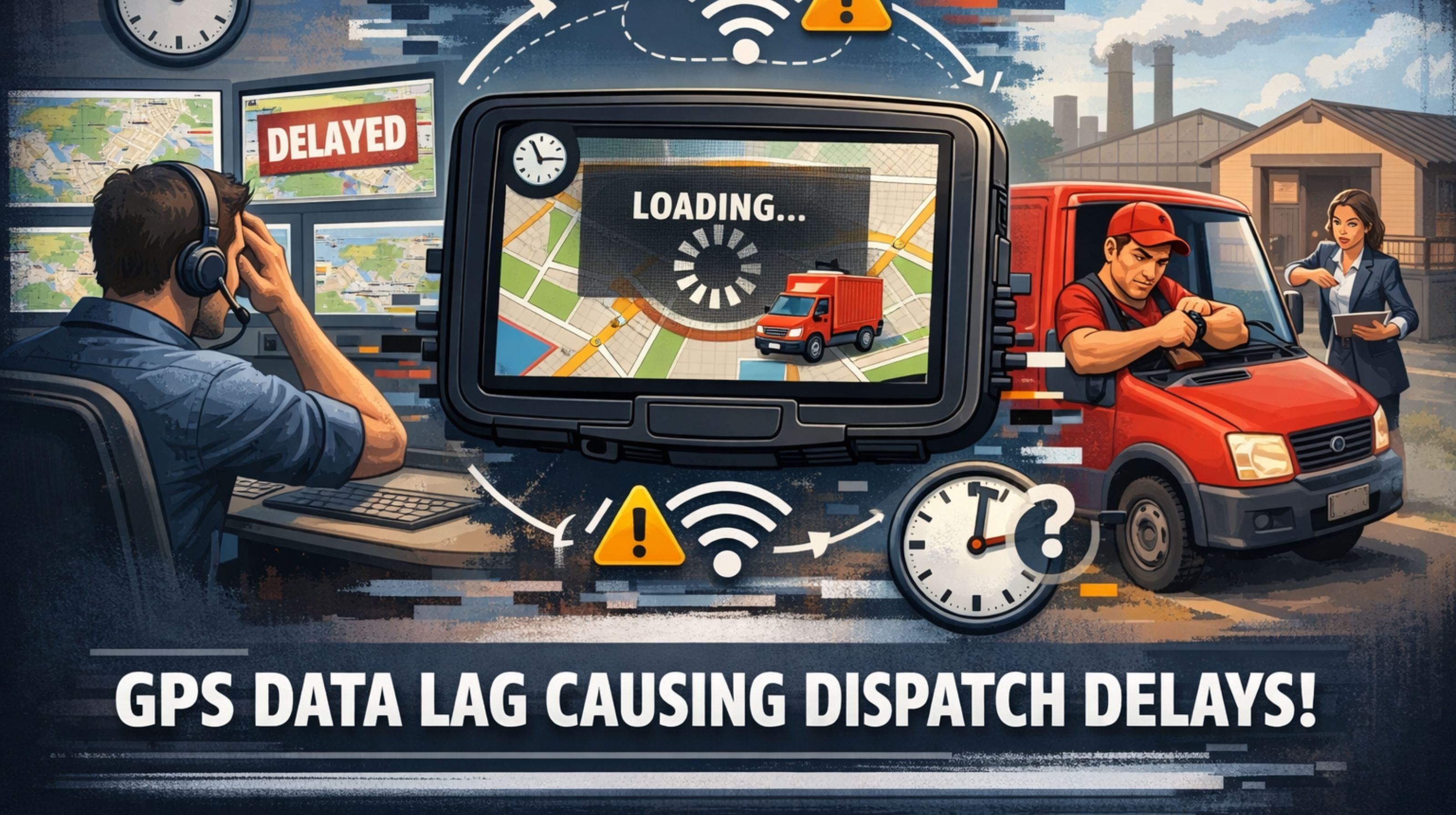
When your GPS controller reports a vehicle's location with a persistent 90-second to 3-minute lag, you're not looking at a minor sync issue—you're managing a breakdown in operational tempo. Honestly, this data latency creates a domino effect where dispatch decisions are based on stale positional data. That leads straight to missed time windows, driver confusion, and a growing disconnect between the planned route and what's actually happening on the street.
What Data Lag Means in Live Fleet Tracking
In a live tracking context, data lag is that gap between a vehicle's true physical location and the dot you see on your dispatch map. This isn't just about refresh rates; it's about the entire data pipeline from the vehicle's GPS module, through the cellular network and the controller's own processing, to your fleet management software. A common mistake—and a critical one—is blaming "slow GPS." More often, the bottleneck is actually the controller's data transmission protocol or how it handles weak cellular signals. Sometimes it'll batch and send data in delayed bursts to save power, which completely destroys any real-time accuracy you were counting on.
The Real-World Impact at Scale
With a fleet of 20+ vehicles, even a consistent two-minute lag forces dispatchers to mentally extrapolate every vehicle's position. You feel the reality check during peak urban traffic: a truck shown as "approaching" a delivery site on your screen has actually been idling, engine-off, for seven minutes. And your delayed fuel and idle reports won't show that fact for another hour. At this scale, minor latency compounds into a scheduling disaster. One delayed update can misalign the entire day's dispatch board, creating invisible congestion and just wasting driver hours.
Common Fixes and Where They Fail
Teams often escalate by rebooting devices, swapping SIM cards, or cranking up map refresh rates—but that's just treating symptoms. The core failure pattern is assuming the lag is purely a network issue. Frequently, it's a controller firmware or configuration problem. Think about it: a controller set to "power-saving" or "extended report interval" mode will intentionally delay data, prioritizing battery life over timeliness. You hit a wall when you've maxed out cellular network quality and tuned all the software settings, but the hardware's processing speed or its outdated communication protocol simply can't achieve the sub-30-second update cadence modern dispatch absolutely requires.
Deciding to Tune, Replace, or Redesign
The decision line is pretty clear. If the lag is inconsistent and tied to specific areas—like tunnels or industrial zones—then reconfiguring the controller's reporting triggers and maybe integrating some complementary IoT sensor data for context might be enough. However, if the lag is persistent, fleet-wide, and starting to impact customer SLAs or driver payroll audits, the internal fix path just isn't enough. That's the point where continuing to patch an outdated or underpowered gps controller system becomes more costly than a planned replacement. The delay is now a baked-in limitation of the hardware's architecture itself.
FAQ
q: What is considered normal lag for GPS tracking?
a: For modern cellular-based tracking, a normal, reliable system should report location within 30-60 seconds of a change. Consistent delays beyond 90 seconds usually mean there's a systemic problem somewhere in the device, network, or software pipeline.
q: Can a bad cellular signal cause permanent data lag?
a: Yes, but the real risk is in how the controller handles it. Poor controllers will store and then dump old data when the signal returns, creating a burst of outdated points that corrupt the timeline, instead of intelligently transmitting the most recent fix first.
q: Does adding more vehicles make data lag worse?
a: It can expose the lag. The system backend might throttle data from individual devices under high load to manage server capacity. That creates an artificial, scale-induced delay that you wouldn't even see with a smaller fleet.
q: When should we replace controllers instead of troubleshooting?
a: When lag persists after you've verified network coverage, updated firmware, and optimized reporting intervals, the bottleneck is likely the hardware. If dispatch decisions are consistently wrong and audit trails don't match the logbooks, the operational cost starts to outweigh the replacement cost for modern devices.


Comments
Post a Comment