Geofence Alert Failure on a Stolen Asset Is a Live Signal Loss
Geofence Alert Failure on a Stolen Asset Is a Live Signal Loss
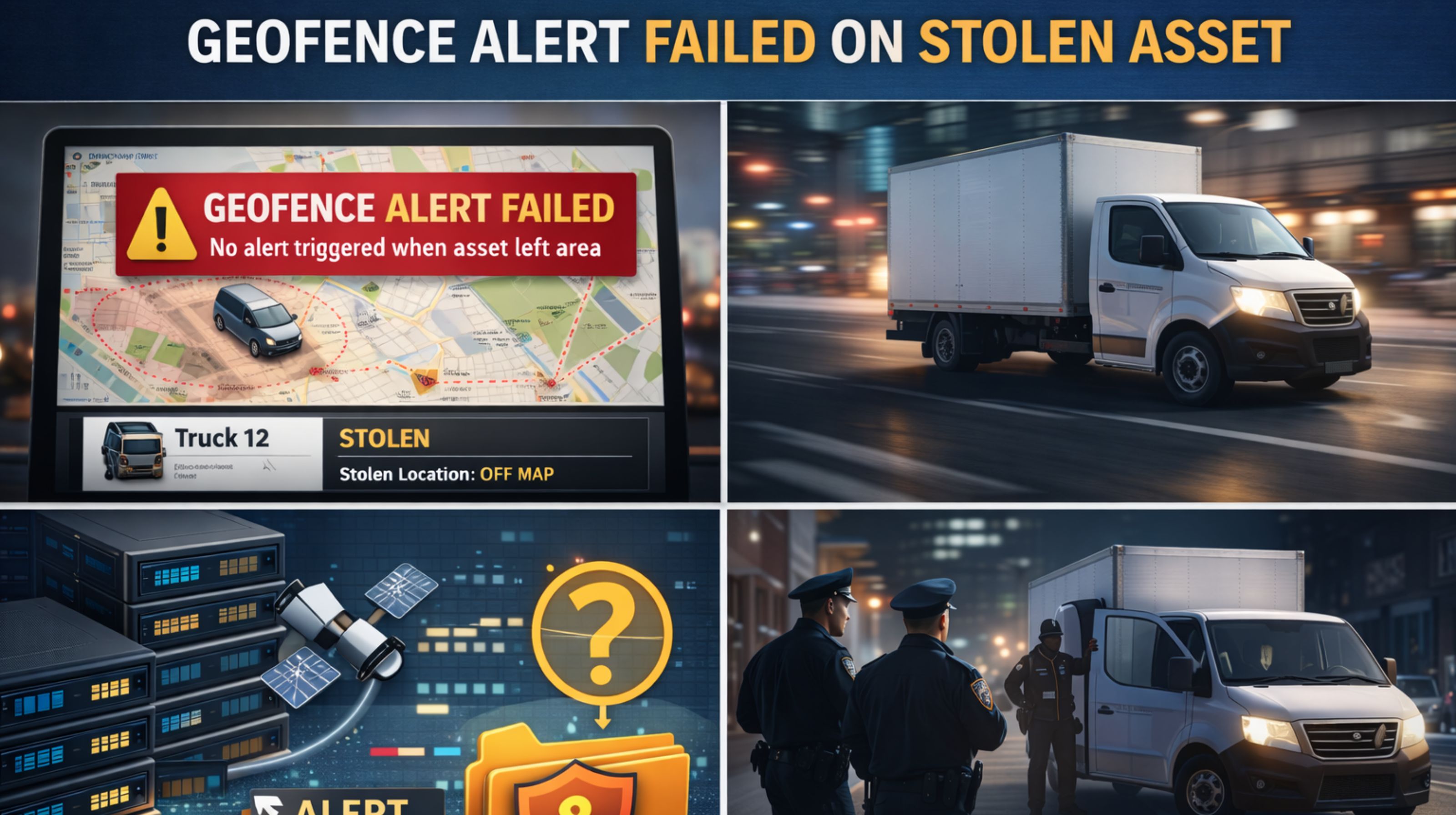
When a geofence alert fails on a stolen asset, it's not a minor software glitch—it's a direct signal loss from the field. What you're looking at is a critical blind spot in your asset tracking, and real-world conditions just found it.
What Geofence Alert Failure Means in Live Asset Tracking
In practice, this failure means your digital perimeter didn't go off. Usually, it's because the tracker lost its GPS or cell connection right as the asset was moved—a frustratingly common problem in urban canyons or during a fast loading operation. The real tell is that missing SMS or email alert. Your security team is left in the dark, sometimes for hours, wondering what happened.
The Reality Under Real Theft or Unauthorized Movement
During an actual theft, every weakness gets exposed. The asset gets shoved into a shipping container or driven underground, and GPS drops immediately. Often, the device can't even send its final "breach" signal due to network issues or because someone tampered with the power. Suddenly, there's a dangerous gap between what your IoT asset monitoring dashboard shows as a last known location and the reality of a moving target.
Common Mistakes and Escalating Risks
A big mistake is chalking the alert delay up to "system lag" and just resending the geofence. That ignores the actual device or network failure. This kind of thinking lets the problem escalate—repeated failures eat away at trust in the system and can really complicate insurance or compliance audits, where you have to prove you were diligently monitoring. Another tricky detail: some devices go into a low-power "sleep" mode when stationary and might not wake up fast enough to catch a rapid breach.
Decision Help: Reconfigure, Redesign, or Replace
The line is pretty clear. If failures are one-offs tied to known dead zones, you can reconfigure—use bigger geofence buffers and maybe add secondary BLE or satellite comms. But if failures keep happening across different assets, you need to redesign the whole monitoring workflow. That means integrating movement sensors with geofencing and moving to a more robust geofencing alert platform. If the core issue is device sensitivity or network reliability, internal fixes won't cut it. That's when a platform like gps controller, with its redundant alert paths, shifts from being a nice software feature to a necessary operational upgrade.
FAQ
q: Why did my geofence not alert when my asset was stolen?
a: Most likely, the tracker lost its GPS or cellular signal the moment the asset crossed the boundary. Without a location fix, it had no data to report the breach.
q: Can a stolen asset still be tracked if the geofence alert failed?
a: It's possible, but it depends. If the device gets signal again later, you might see a new location pop up. But professional thieves often disable trackers quickly, so relying on just one geofence alert is a major risk.
q: How do I prevent geofence alert failure for high-value assets?
a> Use devices with movement-triggered alerts that don't depend on GPS, set up overlapping geofences, and make sure your platform uses multiple notification methods—like SMS, email, and in-app alerts—so you don't have a single point of failure.
q: When should I replace my asset tracking system after a geofence failure?
a: If the failures continue even after you've checked network coverage and device health, and especially if your audit trails are getting messy, it's time to look at new systems. You need ones with hardened alert engines and redundant communication; standard platforms often don't have the security-grade reliability you really need.


Comments
Post a Comment