What Happens When Your Construction Site Geofence Triggers a Theft Alert
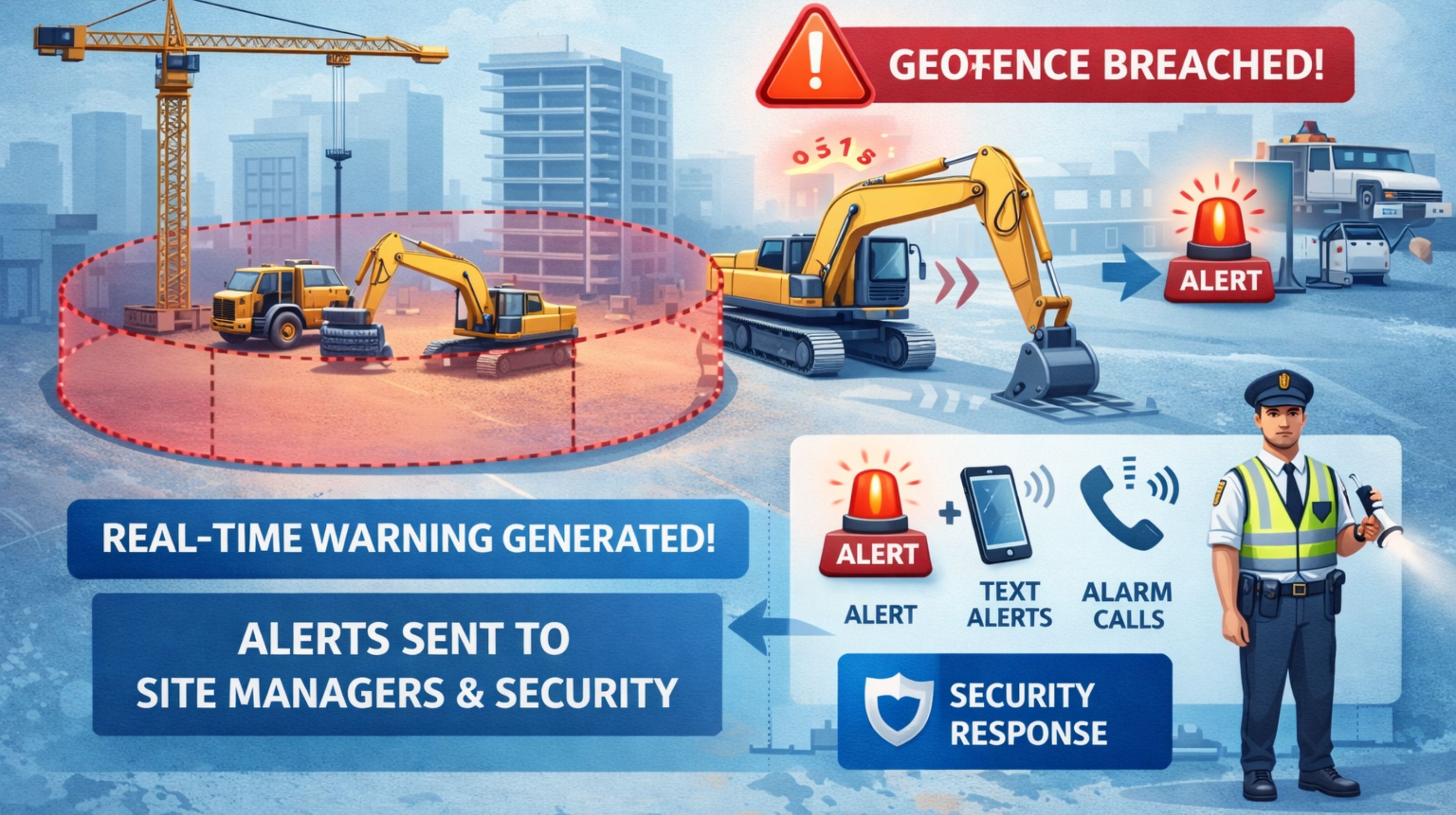
What Happens When Your Construction Site Geofence Triggers a Theft Alert
You get the alert that an asset has moved outside its virtual boundary. In that moment, you're not thinking about the technology; you're deciding whether to call the police, a site supervisor, or just assume it's a false alarm.
What a Geofence Theft Trigger Actually Means on the Ground
In practice, a trigger means the GPS tracker on a skid steer or generator has reported coordinates outside the digital fence you drew on a map. The immediate reality is rarely a clean theft-in-progress; it's often a piece of equipment being moved to an adjacent lot for a quick job, or a low-battery tracker giving a last erratic signal before dying. I've seen more alerts caused by an operator forgetting to notify dispatch than by actual criminals.
The Reality of Responding to a Geofence Alert
Most companies have a protocol, but the middle-of-the-night alert usually plays out the same way: a security manager checks the asset's last location, sees it's in a nearby neighborhood, and calls the site foreman who confirms the machine was loaned to another crew. What people often miss is the velocity and direction data; a machine moving at 55 mph down a highway at 3 AM is a very different signal than one that's just drifted 500 feet over two hours.
The Common Misunderstanding That Costs Time and Money
The biggest mistake is treating every geofence breach as a high-priority theft event. That just leads to alert fatigue, where real alarms get ignored after too many false positives. The technology doesn't discern intent—it only reports a location change. A common oversight? Not setting up graduated alerts for different asset values. A $200,000 excavator leaving the zone should trigger a completely different response than a light tower.
When to Rely on the Trigger and When to Double-Check
This system makes sense when you have high-value, frequently targeted assets and a clear, practiced response chain. It doesn't make sense as a standalone solution on a site with poor cellular coverage or for low-cost tools without dedicated trackers. The trade-off is constant monitoring versus real security; the fence is just a digital line. Its effectiveness hinges entirely on what you do in the ten minutes after the notification hits your phone.
FAQ
How accurate are construction site geofences for theft prevention?
Accuracy depends more on GPS signal and cellular coverage than the software. In urban canyons or dense storage yards, location pings can be off by dozens of feet, sometimes causing false triggers.
What's the typical delay between a theft and the alert?
There's almost always a lag, dictated by the tracker's reporting interval. A device set to report every hour could be miles away before you're notified, which is why real-time or 5-minute intervals are used for high-risk assets.
Can thieves disable or bypass these geofences?
Yes, a common method is simply placing a GPS jammer near the equipment, which blocks the signal entirely. The system won't trigger an alert because it won't receive any data at all, a silent failure many don't plan for.
Is geofencing enough to secure a construction site?
No, it's only one layer. It tells you something left, but doesn't prevent the removal. Effective security combines physical barriers, lighting, human patrols, and the geofence as a final digital tripwire.


Comments
Post a Comment